|
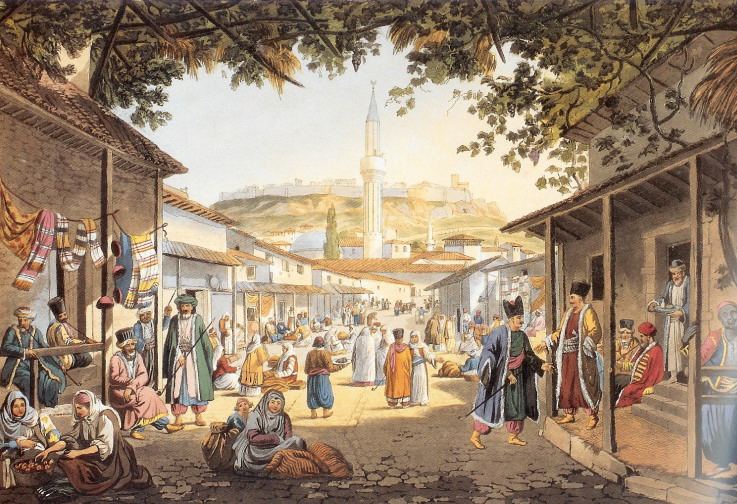
From 1453 with the fall of Constantinople until the revolution in 1821 Greece is under the rule of the Ottoman Turks who control the entire middle east, and the Balkans as far as the gates of Vienna.
|
|
 The
Ottomans are Seljuk Turks, a tribe from Central Asia who appeared in the area of Anatolia in the 11th century. After a period of Mongolian rule, they conquered more and more land until the 15th Century when they were attacking the Byzantine Empire from all sides. With the Venetians in the west and the Turks in the east, the Greeks are sandwiched between two major powers, both taking what they want and fighting over the rest. Unfortunately these battles take place on Greek soil. Though subjugation by any power
is a bitter pill to swallow the Ottomans are preferable to the Venetians. As long as you pay your ridiculously high taxes they let their subjects live their lives, which is mostly working to make enough to pay your taxes and maybe eat. But the Venetians treat their subjects as slaves with no rights. The
Ottomans are Seljuk Turks, a tribe from Central Asia who appeared in the area of Anatolia in the 11th century. After a period of Mongolian rule, they conquered more and more land until the 15th Century when they were attacking the Byzantine Empire from all sides. With the Venetians in the west and the Turks in the east, the Greeks are sandwiched between two major powers, both taking what they want and fighting over the rest. Unfortunately these battles take place on Greek soil. Though subjugation by any power
is a bitter pill to swallow the Ottomans are preferable to the Venetians. As long as you pay your ridiculously high taxes they let their subjects live their lives, which is mostly working to make enough to pay your taxes and maybe eat. But the Venetians treat their subjects as slaves with no rights.
From 1520 to 1566 the Ottoman empire expands under Sultan Suleyman the Magnificent. In Greece the monasteries become the centers of learning and many intellectuals escape there with their books and libraries to keep Hellenism alive during these dark ages, or at least this is the popular mythology. During the reign of Suleyman in the 16th century and into the 17th - the Rumci, as they were called in Turkish: Byzantine descended Greeks, had enormous
privileges under the Turks. If they paid extra taxes it was because they did not serve in the military. More important from the time of Mehmet II the Greek clergy had enormous benefits and were paid by the Ottoman state. The Patriarch was literally the head of all of the Orthodox Christians and had a position like that of the Vizier. His authority was quite emphatic and bishops (for the first time) were funded from Imperial sources as they acted as leaders of the Christian citizens
of the empire and were responsible for their behavior.
|
|
Greeks were put into all of the patriarchates - Jerusalem, Antioch and Alexandria. Arabs were not allowed into the higher clergy and there was actually a form of paedomazoma with young boys taken from Greek villages and sent off to these places to eventually become the clergy. It was a real kind of Greek colonialism. When the Ottoman Empire fell, the civil authority over these patriarchates shifted - eventually it was parceled out between
Syria
(over Antioch), The Jordanese (over Jerusalem) and Egypt (over Alexandria). The very fact that the present-day Greek government (as it did under the Junta) is assuming some sort of right over these Patriarchates is of interest and actually based on no historical precedence... after all, there was no such phenomenon as 'Greece' in a political sense prior to the Revolution of 1821 EVER! For this reason it is also incorrect to say that Greece was occupied by the Turks for 400 years. There was no Greece
to occupy. We use the name Greece to refer to the geographic area in which ancient City States (that were independent countries after all) evolved and fought. In Roman times it was a province as it was during Ottoman times. But when we speak of 'Greece' prior to 1829 we are actually speaking of a geographic territory and not a state since it had never been one. More on the Orthodox Church under the Ottomans
In 1492 when Ferdinand and Isabella proclaim the Edict of Expulsion for the Jews of Spain, Sultan Bayezid II proclaims that Jews from Spain would be welcome in the Ottoman Empire. Over 20,000 Sephardic or Iberian Jews arrive in Thessaloniki the same year. See www.greecetravel.com/jewishhistory/ancient.html
The Ottomans begin conscripting Christian boys from conquered territories like Greece to serve in the Janissary corps. These recruits are given military training and introduced to Islam, and given the task of protecting the life of the Sultan. Some of the recruits are able to ascend to the Ottoman administration as well, even to the position of Grand Vizier. The Janissaries become one of the most powerful military forces in the world. However, their frequent revolts
and refusal
to permit any sort of military reform in the later Ottoman period eventually leads to their downfall. When they fail to suppress a Greek insurrection in 1820, and revolt again in 1826, Sultan Mahmud II dissolves the corps.
|
|
 On the island of Rhodes the Knights of Saint John who had moved there after being evicted
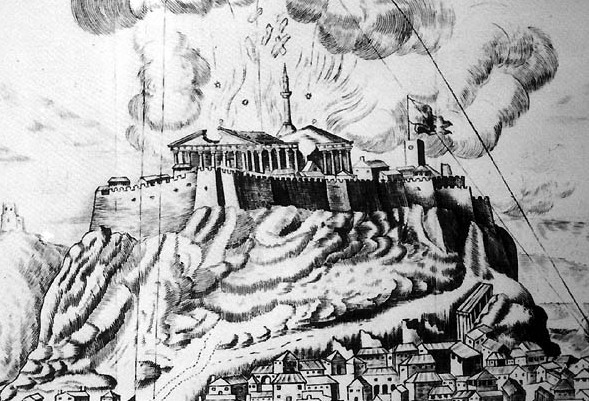
from the Holyland in 1306, have been holding out and striking at the Turks from their fortress city. After a final siege Rhodes falls in 1522 and the Knights leave for Malta. In 1571 Venetian controlled Cyprus falls to the Turks as does Crete in 1669 after a twenty year siege. When the Ottoman attack on Vienna fails in 1683, the combined powers of Christiandom under the leadership of Austria and Venice capture the Peloponessos and attack Athens. On September 26th 1688 the Venetian troops under General Morosini
bombard the Acropolis. The Turks who had taken refuge on the Acropolis had been using the Parthenon, which until then was completely intact, to store munitions (as well as their women and children). They assume the Venetians will never bombard such a historical monument. They are wrong. Though some history books claim a stray shell destroyed the Parthenon, in truth the Venetians had been alerted to the fact that the building was being used as a munitions depot and aim their cannons at it. When the shell hits
the Parthenon, the symbol of classical Hellenic society, democracy and culture is destroyed. The explosion is so powerful that even the Venetians on Philipapos hill are showered with debris and the Turkish houses on the acropolis are destroyed. Over 300 men, women and children die and the Turks surrender the city. Morsini and his troops occupy the Acropolis for a few months but leave the city, taking with them much of the population, making the whole siege and destruction of the ancient temple completely pointless.
Most of the Athenians go to the Peloponessos and Athens is empty for several years, until a Turkish offer of amnesty and three years tax-free convinces a stream of refugees to return and repopulate the ancient city. On the island of Rhodes the Knights of Saint John who had moved there after being evicted
from the Holyland in 1306, have been holding out and striking at the Turks from their fortress city. After a final siege Rhodes falls in 1522 and the Knights leave for Malta. In 1571 Venetian controlled Cyprus falls to the Turks as does Crete in 1669 after a twenty year siege. When the Ottoman attack on Vienna fails in 1683, the combined powers of Christiandom under the leadership of Austria and Venice capture the Peloponessos and attack Athens. On September 26th 1688 the Venetian troops under General Morosini
bombard the Acropolis. The Turks who had taken refuge on the Acropolis had been using the Parthenon, which until then was completely intact, to store munitions (as well as their women and children). They assume the Venetians will never bombard such a historical monument. They are wrong. Though some history books claim a stray shell destroyed the Parthenon, in truth the Venetians had been alerted to the fact that the building was being used as a munitions depot and aim their cannons at it. When the shell hits
the Parthenon, the symbol of classical Hellenic society, democracy and culture is destroyed. The explosion is so powerful that even the Venetians on Philipapos hill are showered with debris and the Turkish houses on the acropolis are destroyed. Over 300 men, women and children die and the Turks surrender the city. Morsini and his troops occupy the Acropolis for a few months but leave the city, taking with them much of the population, making the whole siege and destruction of the ancient temple completely pointless.
Most of the Athenians go to the Peloponessos and Athens is empty for several years, until a Turkish offer of amnesty and three years tax-free convinces a stream of refugees to return and repopulate the ancient city.
|
|
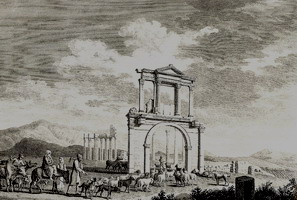 In the late 1700's Athens is ruled by Hadji Ali Haseki, probably the worst ruler ever, who actually bids for the right to govern the city and
then taxes the inhabitants heavily to get his money back. He tears down many of the ancient temples and ransacks churches and buildings for material to build a defensive wall around the city, that is as much to keep people in as it was to keep enemies out. Adding insult to injury after using the Athenians as the physical labor for building these wall he then charges them for the cost of building it. He confiscates for himself any property he wants and throws into prison hundreds of Athenians. By the end of the
century he has been removed, exiled to the island of Kos, his head taken back to Constantinople and displayed as a warning to what happens to those who abuse power in the Ottoman empire. In the late 1700's Athens is ruled by Hadji Ali Haseki, probably the worst ruler ever, who actually bids for the right to govern the city and
then taxes the inhabitants heavily to get his money back. He tears down many of the ancient temples and ransacks churches and buildings for material to build a defensive wall around the city, that is as much to keep people in as it was to keep enemies out. Adding insult to injury after using the Athenians as the physical labor for building these wall he then charges them for the cost of building it. He confiscates for himself any property he wants and throws into prison hundreds of Athenians. By the end of the
century he has been removed, exiled to the island of Kos, his head taken back to Constantinople and displayed as a warning to what happens to those who abuse power in the Ottoman empire.
|
|
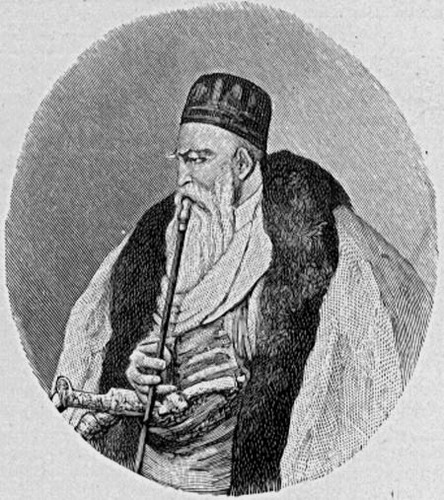 Another colorful personality of the period is Ali Pasha, the Albanian tyrant who in 1787 rules Ipirus for the Ottomans from the town of Ioannina. His dream was to break away from the Ottoman
Empire and create his own independent state in Ipirus, with the collaboration of Napoleon. But In 1798 he forms an alliance with the British and takes Preveza from the French. He is given Parga by the British who see Ali Pasha as a thorn in the side of the Ottomans. Even Lord Byron visits him, as described in his poem Childe Harold, calling Ali Pasha a generous and cultured man and the 'Muslim Bonaparte'. The Ottomans find him useful too but when he orders the assassination of an opponent in Constantinople, Sultan
Mahmud II has had enough and sends troops to depose him. 20,000 Turkish troops are diverted from fighting the rebellious Greeks in the Peloponessos finally forcing Ali Pasha to surrender after agreeing to pardon him. While waiting in the Pantelimon Monastery for his pardon to be read, he is executed, his head displayed for 3 days in Ioanina and then sent to Constantinople where it is displayed there as well. His body is buried in Ioannina, his head in Constantinople. Though a sick and perverted individual who murdered
and tortured who he pleased, he was a ruthless and clever leader and played an important part in the independence of Greece from the Ottomans by engaging the Turkish troops when they might have been fighting the Greeks. Another colorful personality of the period is Ali Pasha, the Albanian tyrant who in 1787 rules Ipirus for the Ottomans from the town of Ioannina. His dream was to break away from the Ottoman
Empire and create his own independent state in Ipirus, with the collaboration of Napoleon. But In 1798 he forms an alliance with the British and takes Preveza from the French. He is given Parga by the British who see Ali Pasha as a thorn in the side of the Ottomans. Even Lord Byron visits him, as described in his poem Childe Harold, calling Ali Pasha a generous and cultured man and the 'Muslim Bonaparte'. The Ottomans find him useful too but when he orders the assassination of an opponent in Constantinople, Sultan
Mahmud II has had enough and sends troops to depose him. 20,000 Turkish troops are diverted from fighting the rebellious Greeks in the Peloponessos finally forcing Ali Pasha to surrender after agreeing to pardon him. While waiting in the Pantelimon Monastery for his pardon to be read, he is executed, his head displayed for 3 days in Ioanina and then sent to Constantinople where it is displayed there as well. His body is buried in Ioannina, his head in Constantinople. Though a sick and perverted individual who murdered
and tortured who he pleased, he was a ruthless and clever leader and played an important part in the independence of Greece from the Ottomans by engaging the Turkish troops when they might have been fighting the Greeks.
|
|
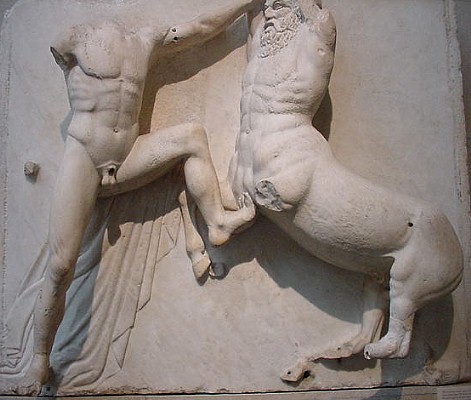 Athens
begins a period of renewed scholarly and artistic activity and also to
see the first wave of 'tourists' who discover the ancient monuments and treasures
of the Hellenes. Athens is filled with students of classical art and architecture
and Turks and Greeks begin breaking off pieces of the Parthenon
and selling them. By the eighteenth century many of these
early travelers are
returning with tales of the glory of ancient Greece and bits and pieces of ancient
Greek history, while some, like Lord
Elgin return with actual monuments and statues like the Parthenon Marbles,
or what are known as the Elgin Marbles. This sets off a fervor for anything Greek. To the intellectuals
of Europe and Great Britain in particular the ancient Greeks are like gods,
their art and thinking at a level that modern people can only hope to one
day attain. It is this admiration of Greece by the Europeans that is to be the
most important ally in their fight for independence from the Turks. Athens
begins a period of renewed scholarly and artistic activity and also to
see the first wave of 'tourists' who discover the ancient monuments and treasures
of the Hellenes. Athens is filled with students of classical art and architecture
and Turks and Greeks begin breaking off pieces of the Parthenon
and selling them. By the eighteenth century many of these
early travelers are
returning with tales of the glory of ancient Greece and bits and pieces of ancient
Greek history, while some, like Lord
Elgin return with actual monuments and statues like the Parthenon Marbles,
or what are known as the Elgin Marbles. This sets off a fervor for anything Greek. To the intellectuals
of Europe and Great Britain in particular the ancient Greeks are like gods,
their art and thinking at a level that modern people can only hope to one
day attain. It is this admiration of Greece by the Europeans that is to be the
most important ally in their fight for independence from the Turks.
|
|